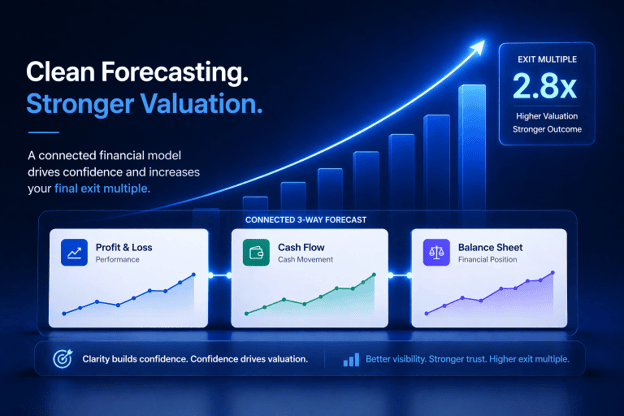

A dark blue finance-themed growth graphic showing an upward curved line with milestones: Understand, Plan, Monitor, and Decide. Below the line are three dashboard cards for Profit & Loss, Cash Flow, and Balance Sheet, each showing positive financial metrics and small trend charts. The headline reads “Growth with clarity. Backed by connected finances,” emphasizing connected forecasting, real-time visibility, aligned teams, and confident growth.

Why Growing Too Fast Is the #1 Killer of Profitable UK Businesses (and How to Spot the Signs)

Growth is usually viewed as a positive signal in business. But for many SMEs, rapid growth creates financial pressure long before operational problems become obvious. This is because growth changes: all at the same time. A business can become commercially stronger while at the same time becoming financially weaker. The issue is rarely growth itself….

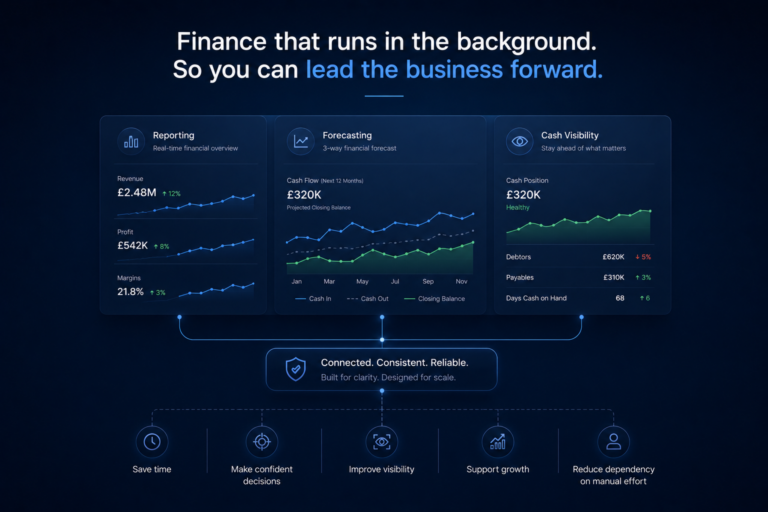
Minimal finance dashboard showing connected reporting, forecasting, and cash visibility, designed to reduce manual founder dependency and support scalable SME decision-making.

How to Build a Finance Function That Works Perfectly Even When You’re on Holiday

Many growing SMEs eventually reach a point where the finance function depends too heavily on the business owner. The numbers still work. But only because someone is constantly: That approach does not scale reliably. A stronger finance function is not one that removes people entirely. It is one where: even when the owner is not…

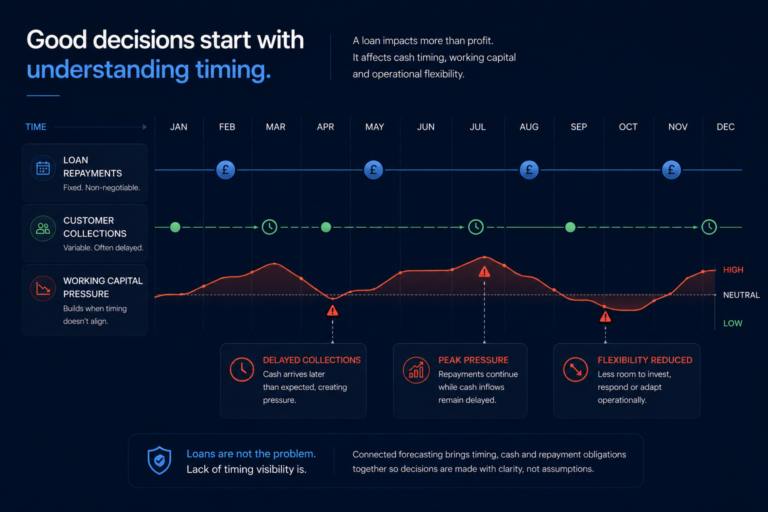
Dark blue infographic showing a 12-month timeline of loan repayments, customer collections, and working capital pressure. Fixed loan repayment dates appear as blue pound symbols across the year, while green customer collection points are shown as variable and often delayed. A red line tracks working capital pressure, rising and falling as timing gaps occur, with callouts for delayed collections, peak pressure, and reduced flexibility. The message emphasizes that loans are not the problem; lack of timing visibility is.

When Is a Business Loan an “Engine” for Growth Versus an “Anchor” for Your Cash Flow?

A business loan becomes useful when the business can absorb the financial pressure operationally, not just when the growth opportunity looks attractive. Many SMEs evaluate borrowing primarily through: But loans affect much more than profit. They also affect: The difference between growth-supporting debt and cash flow pressure usually comes down to how well the business…

Investor-ready financial pack showing Series A revenue, growth, cash flow and scale metrics for startup funding discussions

The Investor-Ready Pack: What Series A Investors Expect to See

An investor-ready pack is not a collection of reports. It is a structured view of how your business performs, generates cash, and scales. Series A funding is the first significant round of venture capital financing, where early-stage startups raise capital (typically $5M–$15M+) to optimise their product-market fit, scale operations, and accelerate growth. It follows seed…

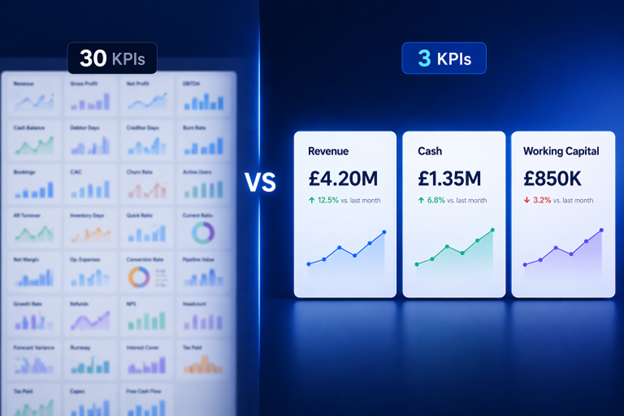
Comparison of an overloaded dashboard with 30 KPIs versus a focused dashboard with 3 KPIs for revenue, cash and working capital

The Minimalist Dashboard: Why 3 KPIs You Actually Use Beat 30 You Don’t Understand

A dashboard is only useful if it leads to decisions. Most businesses track too many metrics, creating noise instead of clarity. A small number of well-chosen KPIs, understood and acted upon, will always outperform a large set of poorly used ones. In practice, this usually comes down to three connected measures: The objective is not…

Financial reports showing profit and loss, bank balance, and forecast not aligning as business growth creates cash flow complexity

When Traditional Bookkeeping Stops Working: The Growth Gap Most SMEs Hit

There is a point in your business where the numbers stop making sense. You’re looking at: This is the point where bookkeeping stops being enough. Key Takeaways What It Looks Like When You’re Still In “Small Business” Mode Early on, the financial model is simple. You can operate with: At this stage, that is enough….

Graphic titled “Financial Due Diligence Red Flags: What Buyers Look For and How to Fix Them.” It shows three labeled boxes,“Profit & Loss,” “Cash Flow,” and “Balance Sheet”—connected by a fluctuating line graph. Red warning signs with exclamation marks appear above the boxes, suggesting potential financial issues in each area.

Financial Due Diligence Red Flags: What Buyers Look For and How to Fix Them

Financial due diligence does not introduce new issues. It identifies existing ones. Red flags typically arise from inconsistencies, lack of clarity, or weak financial structure. These issues reduce buyer confidence and can lead to valuation adjustments, delays, or changes in deal terms. Preparing for due diligence means resolving these issues in advance, not explaining them…

Working Capital Optimisation: Unlocking “Hidden Cash” to Fund Growth Without Debt

Working Capital Optimisation: Unlocking “Hidden Cash” to Fund Growth Without Debt

Many businesses look externally for funding when they need to grow. In reality, a significant portion of that funding already exists within the business. Working capital represents cash tied up in receivables, payables, and inventory. When these are not managed effectively, cash becomes delayed, restricted, or invisible. Optimising working capital is not about generating new…

How to build a cash flow forecast

The Hidden Cost Of “Finance Bloat”: Why Big Departments Often Produce Slower Decisions

Larger finance teams do not necessarily produce better decisions. In many cases, they slow them down. As finance functions grow, they accumulate layers of process, reporting, and approval. This increases complexity, delays the flow of information, and distances decision-makers from the underlying reality of the business. The issue is not the size itself. It is…

forecasting-done-properly-fd-pack

Why Month-End Shouldn’t Take Weeks (And What’s Really Slowing It Down)

A slow month-end is not a timing problem. It is a structural one. When closing the books takes weeks, it usually reflects issues with data quality, process discipline, and system design. The delays are not caused by the closure itself, but by the work that needs to be corrected before it can happen. A fast…