
Working Capital Optimisation: Unlocking “Hidden Cash” to Fund Growth Without Debt

Working Capital Optimisation: Unlocking “Hidden Cash” to Fund Growth Without Debt

Many businesses look externally for funding when they need to grow. In reality, a significant portion of that funding already exists within the business. Working capital represents cash tied up in receivables, payables, and inventory. When these are not managed effectively, cash becomes delayed, restricted, or invisible. Optimising working capital is not about generating new…

How to build a cash flow forecast

The Hidden Cost Of “Finance Bloat”: Why Big Departments Often Produce Slower Decisions

Larger finance teams do not necessarily produce better decisions. In many cases, they slow them down. As finance functions grow, they accumulate layers of process, reporting, and approval. This increases complexity, delays the flow of information, and distances decision-makers from the underlying reality of the business. The issue is not the size itself. It is…

forecasting-done-properly-fd-pack

Why Month-End Shouldn’t Take Weeks (And What’s Really Slowing It Down)

A slow month-end is not a timing problem. It is a structural one. When closing the books takes weeks, it usually reflects issues with data quality, process discipline, and system design. The delays are not caused by the closure itself, but by the work that needs to be corrected before it can happen. A fast…

when-to-hire-a-cfo-fd-pack

Building an Exit-Ready Finance Function: What to Fix 24 Months Before a Sale

An exit-ready finance function is not created at the point of sale. It is built in advance by ensuring that financial information is accurate, structured, and capable of withstanding scrutiny. Many businesses approach this by adding more reports, more detail, and more analysis. The problem is not a lack of information. It is too much…

Difference between transactional and trend-based forecasting for UK SMEs

Transactional vs. Trend-Based Forecasting: Why “Last Year + 10%” Fails Ambitious SMEs

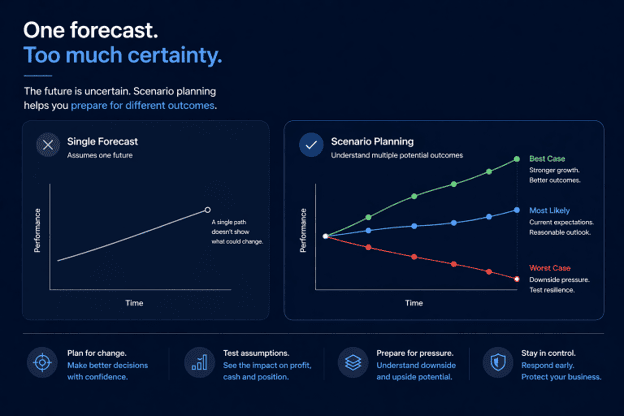
Trend-based forecasting relies on historical averages to project future performance, typically by applying a percentage increase to prior year figures. Transactional forecasting builds a model from the bottom up, integrating specific invoices, tax liabilities, and payroll events. While trend-based models are easier to build, they fail to account for the timing of cash movements, the…

Financial information investors want to see before investing

What is 3-Way Forecasting? The Definitive Guide for Ambitious SMEs

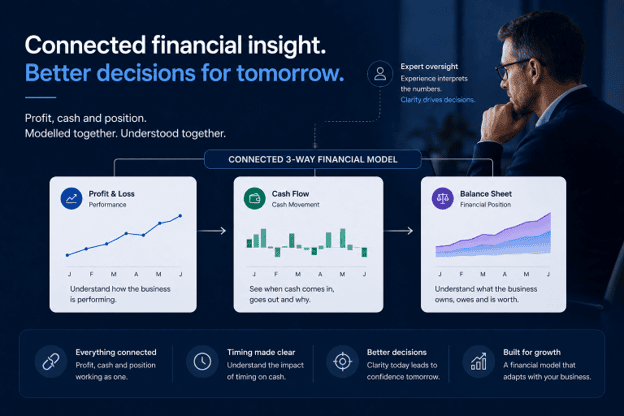
3-way forecasting is a financial modelling methodology that integrates the Profit and Loss (P&L), Balance Sheet, and Cash Flow Statement into a single, synchronised system. Unlike static budgeting, it ensures every projected transaction automatically updates all three reports, providing a mathematically certain view of future liquidity. It is the “Gold Standard” because it eliminates the…