

Financial Drag: How to Audit Your Reporting for Maximum SME Agility
A finance audit for reporting drag is a systematic process of identifying and removing redundant data, overly complex structures, and reactive processes within a company’s financial function.
By stripping the accounting engine down to its essential drivers and implementing a 3-way integrated system, an SME can move from “post-mortem” reporting to a state of constant, decision-ready agility.
At FDPack, our approach is guided by the principle: “Simplify, then add lightness.” In an ambitious SME, “lightness” is the ability to make high-stakes decisions without the weight of messy data or slow reporting cycles.
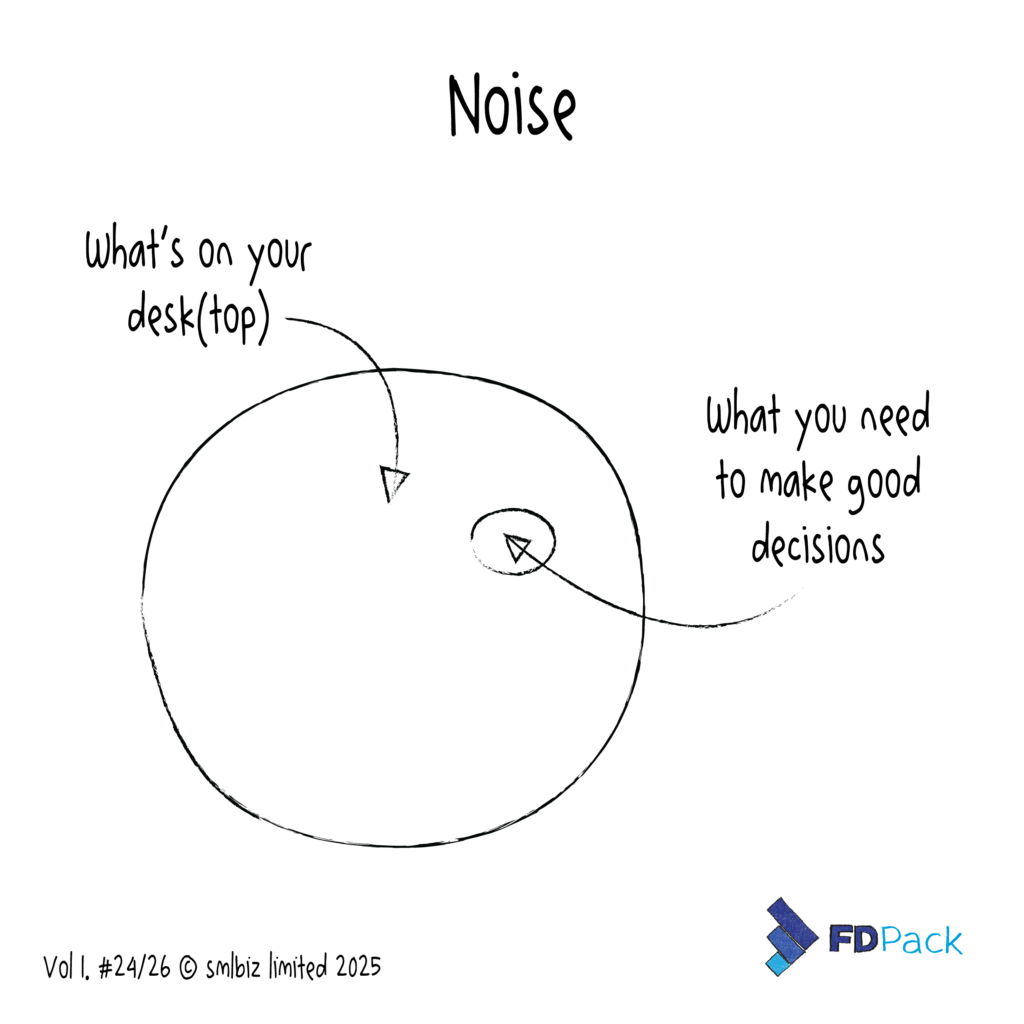
Most £1M–£10M turnover firms are “overweight”, carrying too many ledger codes and 40-page report packs that act as an anchor rather than an engine.
Why Do Most Ambitious SMEs Carry Excess Financial Weight?
Financial “drag” occurs when the effort required to produce a report exceeds the value of the insight it provides. For growth-stage firms, this complexity is usually a byproduct of scaling, new categories are added to the ledger, new spreadsheets are bolted on, and the month-end process becomes increasingly sluggish.
According to research by The Hackett Group, world-class finance organisations operate with 45% lower costs than typical companies because they relentlessly eliminate manual drag and low-value transactional processing.
In the average SME, this drag is often hidden in the hours staff spend manually reconciling spreadsheets, time that should be spent on strategic manoeuvring.
Furthermore, Gartner research indicates that 90% of corporate strategies will explicitly mention information as a critical enterprise asset by 2026, yet few SMEs have the “light” infrastructure to utilise it.
When data is buried in complex, disconnected sheets, it loses its integrity. You stop making decisions based on facts and start relying on “gut feel,” creating significant risk during scaling or investor due diligence.
What Are The Three Stages Of A Strategic Finance Audit?
This audit is not a compliance check; it is a re-engineering of your financial infrastructure. We follow three specific stages to move a business from “cluttered” to “decision-ready.”
1. Rationalise the Chart of Accounts to remove data noise
The Chart of Accounts (CoA) is the chassis of your finance function. Most SMEs have a CoA that is far too heavy, containing hundreds of codes for minor expenses that offer no strategic value. We strip this down.
If a category doesn’t help an owner make a better decision, such as “should I hire?” or “should I pivot?”, it is consolidated. A simplified CoA makes bookkeeping faster and ensures your P&L is readable at a glance.
2. Strip Away Redundant Reports To Focus On Decision Drivers
We audit every report currently generated by the business. Any report that is not used to trigger a specific action is deleted.
We focus the owner on the 3–5 Key Performance Indicators (KPIs) that actually move the needle, such as Monthly Recurring Revenue (MRR), Customer Acquisition Cost (CAC), or Gross Margin, rather than burying them in a 50-page board pack that no one has time to read.
3. Implement 3-Way Integration To Restore Handling
Once the system is lean, we link the P&L, Balance Sheet, and Cash Flow into a single, transactional loop. This is the difference between a static budget and a “rolling” forecast.
Because actuals are “knitted” into the forecast every month, the business gains the ability to navigate sharp market turns. If your revenue projections change, your tax liability and bank balance update automatically.
What Are The Expected Outcomes Of A Minimalist Audit?
When you remove the drag, you fundamentally change the performance and value of the business.
| Feature | The “Heavy” Way (Pre-Audit) | The “Light” Way (Post-Audit) |
| Month-End Close | 15–20 days (Reactive) | 3–5 days (Agile) |
| Reporting Volume | 40+ pages of “noise” | 1–3 pages of “insight” |
| Data Integrity | Spreadsheet-dependent | System-integrated (Verified) |
| Forecasting | “Last Year + 10%” | 3-Way Rolling (Certainty) |
| Strategic Focus | Managing the past | Designing the future |
What Are The 5 Rules For Stripping Drag From Your Finance Function?
1. Prioritise “So What?” Metric
Every line item on your report should answer a specific question. If you look at a metric and can’t say “so what?”, it’s a drag. Remove it to create clarity and focus.
2. Fix The Engine Before You Paint The Car
Don’t invest in flashy Business Intelligence (BI) tools if your underlying bookkeeping is messy. An audit must start with a hands-on cleanup of your ledger standards.
3. Bridge The Gap Between Profit And Cash
Profit is an opinion; cash is a fact. A proper audit ensures that your reporting explains exactly how your P&L performance translates into physical liquidity on the Balance Sheet.
4. Automate The Manual “Heavy Lifting”
If your team is manually moving data from Xero to Excel, you have high drag. Using a “Software + Service” model can reduce the time spent on data gathering by up to 20%, according to industry benchmarks for automated finance functions.
5. Treat Your Finance Function As A Product
Your financial reports should be as user-friendly as your business’s product. If they are too complex for an owner to interpret in five minutes, they have failed the test of essentialism.
Stop Fighting The Data And Start Using It
Most SMEs are slowed down by the very thing meant to help them: their financial data. If your reporting feels heavy, confusing, or simply “too much,” it is time to simplify.
By stripping away the drag and focusing on the essentials, you gain the agility to out-manoeuvre larger competitors and the clarity to grow with certainty.
Is your finance function a weight or a wing?
FAQs
How Can I Tell If My Reporting Has Too Much “Drag”?
If you feel “blind” in the middle of the month or if your financial reports lead to more questions than answers, you have significant drag. Another sign is a month-end process that takes more than 10 working days.
Is This Audit Different From What My Current Accountant Does?
Yes. Accountants focus on compliance and historical record-keeping. A strategic audit is conducted by an FD specifically to improve future-facing decision-making and operational agility.
Why Is The Chart Of Accounts The First Thing You Fix?
Because it is the foundation. If the foundation is cluttered with unnecessary codes, the resulting data will always be noisy and slow to produce.
Can “Lightening” My Finance Function Help Me Raise Investment?
Absolutely. Investors pay a premium for “clean” businesses with systemised data. It proves that you are in control of your numbers and that your business is built to scale without adding friction.

