
How Can Project-Based Businesses Grow Without Losing Control Of Cash?
Growth creates a unique challenge for project-based businesses.
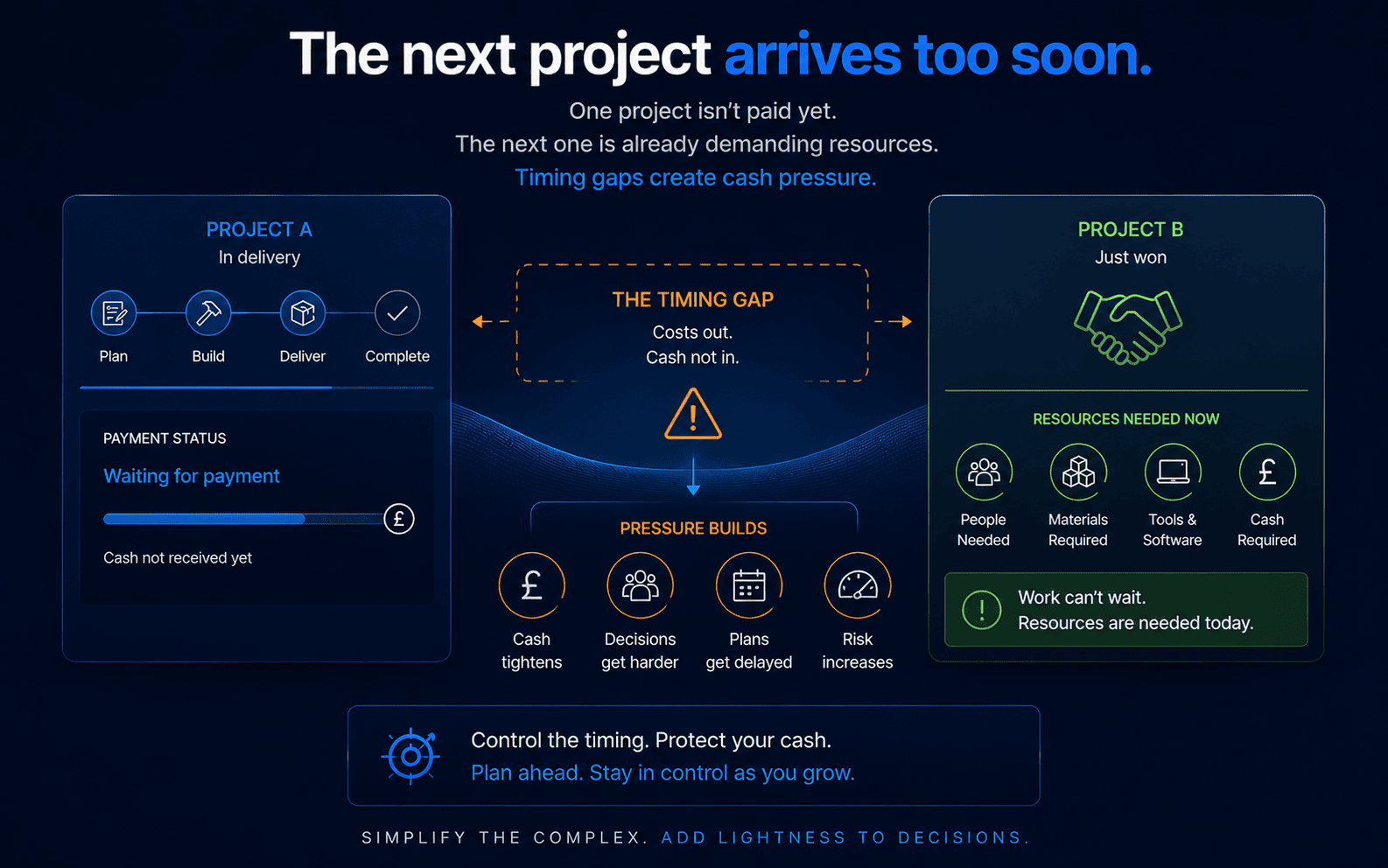
The next project often arrives before the previous one has been paid for.
That sounds manageable when projects are small.
As projects become larger, the gap becomes more important.
The challenge is not winning the next project.
The challenge is understanding what those projects require before commitments are made.
- More people may be needed.
- More costs may need to be committed.
- More cash may leave the business before it returns.
The issue is not winning work.
It is understanding the financial consequences of that work before pressure starts building elsewhere.
Key Takeaways
- Growth can increase cash pressure even when projects remain profitable
- Delayed projects often create bigger problems than delayed payments
- Revenue timing is just as important as revenue value
- Hiring decisions become riskier when project timelines move
- 3-way forecasting helps businesses understand timing risks earlier
- Strong project businesses plan around cash movements, not just project wins
Why Can Winning More Projects Create More Cash Pressure?
Most business owners expect growth to improve financial performance.
In project-based businesses, the opposite can happen.
- A new project is won.
- Additional people are hired.
- Contractors are brought in.
- Software, equipment, or materials are purchased.
The costs start immediately. The cash often arrives much later.
Growth increases activity.
It also increases the number of decisions being made before cash has arrived.
- More people may be hired.
- More costs may be committed.
- More assumptions are built into future plans.
This is one reason profitable project businesses can still experience financial pressure.
What Happens When A Large Project Gets Delayed?
Many project businesses depend on a relatively small number of significant projects.
That creates concentration risk.
One delayed project rarely affects revenue alone.
- Revenue arrives later.
- Cash arrives later.
- Hiring decisions become less certain.
- Future commitments may need revisiting.
What appears to be a project delay often becomes a wider financial issue.
The impact often reaches further than expected.
A project delayed by eight weeks does not simply delay revenue.
It can affect the timing of everything built around that revenue.
This is why project businesses need to understand timing as well as profitability.

Why Does Timing Matter More Than Most Owners Realise?
According to UK Government research, businesses are owed approximately £26 billion in late payments at any given time.
For project businesses, payment delays are only part of the picture.
- Project timelines move.
- Approvals take longer.
- Milestones shift.
- Sign-off dates change.
The result is that cash often arrives later than expected.
The issue is not necessarily the amount. It is the timing.
A business can be profitable on paper and still find itself making difficult decisions because cash has arrived later than planned.
Why Is Capacity Planning Just As Important As Cash Planning?
Many project businesses grow by adding capacity.
- More staff.
- More contractors.
- More delivery capability.
The logic makes sense.
The challenge is that capacity often becomes a fixed cost before project income becomes cash.
This is where businesses can unintentionally become heavier than they need to be.
- Additional costs are committed.
- Future projects are expected.
Then timelines move.
The issue is rarely growth itself.
The issue is making decisions before understanding their financial consequences.
As projects become larger, small shifts in delivery schedules, payment dates, and resource requirements become more significant.
The businesses that manage growth most effectively are usually the ones that understand those pressures before they become visible in the accounts.
How Do Growing Businesses Avoid Hiring Too Early?
This is one of the hardest decisions for project-based businesses.
- Hire too late and delivery suffers.
- Hire too early, and cash comes under pressure.
Neither option is ideal.
The answer is not guesswork.
Every hiring decision is effectively a forecast.
The business is committing costs today based on work expected tomorrow.
- If project timing changes, utilisation changes.
- If utilisation changes, profitability changes.
- If profitability changes, future cash requirements change.
What looks like an operational decision often becomes a financial one very quickly.
How Can Forecasting Help Businesses See Timing Risks Earlier?
According to the Federation of Small Businesses, 52% of small firms experienced late payment during the previous three months.
For project businesses, a delayed payment rarely arrives on its own.
It often sits alongside changing project timelines and future commitments.
This is where forecasting becomes valuable.
Not because it predicts the future perfectly.
Because it helps businesses understand how different outcomes affect cash, capacity, and future decisions.
This is why connected forecasting matters so much in growing project businesses.
A project delay rarely affects one number.
- Revenue shifts.
- Cash arrives later.
- Future commitments become harder to assess.
The business moves as one connected system.
Financial information should reflect those same relationships.
This is why profit, cash flow, and financial position need to be understood together rather than separately.
That is forecasting done properly.
Growth Depends On Timing, Not Just Revenue
Most project businesses do not struggle because they lack opportunities.
They struggle because growth introduces more moving parts.
- Projects move.
- Payments move.
- Costs rarely wait.
The businesses that grow most effectively understand those timing risks before they start affecting decisions.
They focus on understanding how today’s project decisions affect tomorrow’s financial position.
They keep financial planning simple enough to be useful.
And they build finance functions around decision-ready numbers, always.
Traditional finance often responds to growth by adding more reports, more spreadsheets, and more complexity.
That creates weight.
FDPack takes a different approach.
By connecting management accounts, forecasting, and cash visibility through a single 3-way model, businesses gain a clearer understanding of how project decisions affect future financial outcomes.
Growth becomes easier to manage when the numbers remain simple, connected, and decision-ready.
Because in project-based businesses, growth is rarely limited by demand.
More often, it is limited by timing.
FAQs
Why do project-based businesses experience cash pressure during growth?
Because costs are often committed before project payments are received, creating timing gaps between spending and cash collection.
Why can a delayed project affect more than revenue?
Because project delays can affect hiring plans, resource allocation, cash flow, and future project delivery.
What is the biggest financial risk for project-based businesses?
One of the biggest risks is making decisions based on expected project timing that later changes.
How does three-way forecasting help project businesses?
It helps businesses understand how changes in project timing affect profitability, cash flow, and future plans together.
Why is timing more important than revenue alone?
Because revenue does not determine when cash arrives. Project businesses need to understand both value and timing to grow sustainably

