
Why Rising Supplier Costs Often Cause Bigger Problems Than Businesses Expect
Most business owners expect rising supplier costs to reduce margins.
What they often miss is everything that happens next.
- Cash gets tighter.
- Forecasts become less reliable.
- Hiring plans get delayed.
- Growth decisions become harder.
The issue is rarely the cost increase itself.
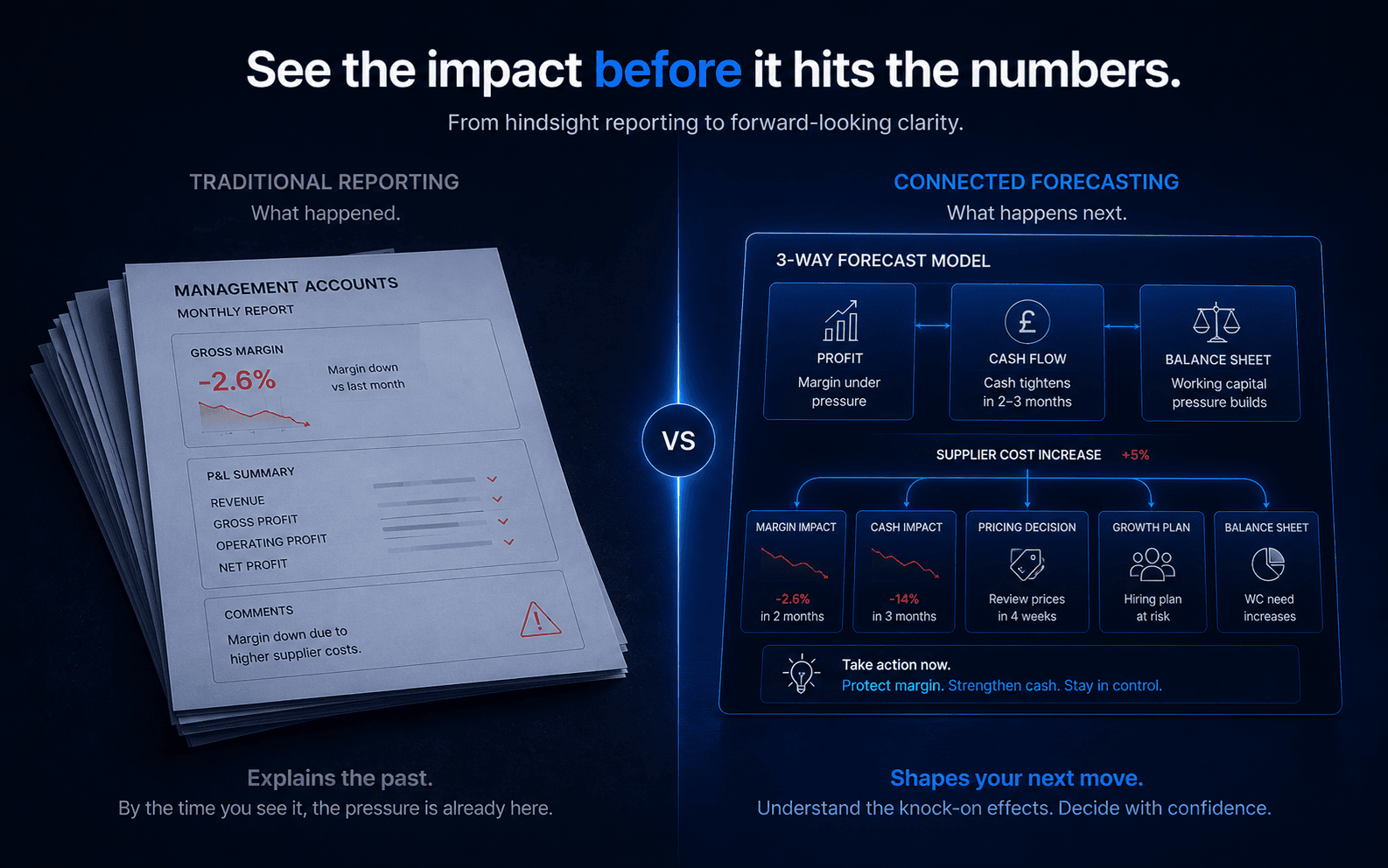
The issue is understanding how that increase moves through the business before it appears in the monthly accounts.
By the time the impact shows up clearly in the numbers, the pressure has often been building for months.
Key Takeaways
- Rising supplier costs affect more than profit margins
- Small increases can create wider pressure across the business
- Most businesses see the impact too late because they rely on historical reporting
- Margin pressure often reaches cash flow before management expects it
- 3-way forecasting helps businesses understand the knock-on effects earlier
- The strongest finance functions focus on what happens next, not just what happened last month
Why Do Small Cost Increases Create Bigger Problems Over Time?
Supplier costs rarely jump overnight.
More often, they creep up gradually.
A price increase from one supplier.
Higher freight costs. More expensive materials.
A small rise here. Another rise there.
Each change looks manageable on its own.
The business, however, feels the combined effect.
British Business Bank analysis of SME Finance Monitor data found that 76% of smaller UK businesses said they had been affected by cost increases in recent months.
For many businesses, the challenge is not one large increase.
It is the accumulation of many smaller ones.
That is why cost pressure often feels sudden, even when it has been building for months.
Why Do Many Businesses Notice The Impact Too Late?
Most reporting looks backwards.
It tells you what happened.
That remains important.
But rising supplier costs become a future problem long before they become a historical one.
By the time the margin pressure appears clearly in a management report:
- supplier decisions have already been made
- pricing decisions may have been delayed
- cash commitments already exist
The numbers are explaining the result.
The pressure started much earlier.
That gap is where many businesses lose valuable time.
What Happens When Costs Rise But Pricing Doesn’t?
This is where pressure starts spreading through the business.
- Sales remain healthy.
- Revenue remains stable.
- Customers keep buying.
Yet profitability begins moving in the wrong direction.
Office for National Statistics data showed that 28% of trading UK businesses reported an increase in the prices of goods or services bought in January 2025 compared with December 2024.
The issue is rarely spotting that costs have increased.
The issue is understanding what those increases mean before they affect future decisions.
A small reduction in margin may not look significant on paper.
Across hundreds of transactions, projects, or customer orders, it quickly becomes something much bigger.
The problem is rarely the size of the increase.
It is how long the business absorbs it before responding.

Why Does Cash Often Feel The Impact Before Profit?
Many business owners naturally focus on the profit and loss account.
The problem is that cash often reacts first.
- Supplier invoices increase immediately.
- Price increases take time to implement.
- Working capital requirements grow.
- Cash leaves the business before additional revenue arrives.
What begins as a margin issue can quickly become a cash issue.
This is why rising supplier costs often feel more painful than the percentage increase suggests.
The effect moves through multiple parts of the business at once.
How Do Growing Businesses See The Knock-On Effects Earlier?
Looking at profit alone rarely tells the full story.
Neither does looking at cash in isolation.
The strongest businesses understand how decisions affect:
- profit
- cash flow
- the balance sheet
Together.
Not separately.
This is where many finance processes become heavier than they need to be.
- Profit sits in one report.
- Cash sits somewhere else.
- Forecasts live in a spreadsheet.
Then somebody has to connect everything together manually.
The result is more work, slower decisions, and less confidence in what happens next.
How Does Three-Way Forecasting Help Businesses Respond Faster?
When supplier costs change, the most useful question is not: “What happened?”
It is: “What happens next?”
This is why FDPack puts so much emphasis on three-way forecasting.
- Many businesses forecast profit.
- Some review cash separately.
- The balance sheet often gets reviewed later.
The business does not behave that way.
Everything moves together. 3-way forecasting connects those movements from the start.
That makes it easier to understand:
- how margin changes affect cash
- whether pricing decisions need reviewing
- what impact cost increases have on future plans
- where financial pressure is likely to build
The goal is not another report.
The goal is forecasting done properly.
So decisions can be made before problems become expensive.
Cost Pressure Is Easier To Manage Than Surprise
Most businesses will experience rising supplier costs.
That is part of running a business.
The bigger challenge is understanding what those costs mean before they start affecting performance.
Because once pressure reaches the accounts, valuable time has already been lost.
The strongest businesses focus on seeing the knock-on effects early.
They simplify the information that matters.
They remove friction from decision-making.
And they build finance functions around decision-ready numbers, always.
FDPack helps growing businesses do exactly that through expert financial leadership and connected three-way forecasting.
Because supplier costs are rarely the real problem.
Being surprised by their impact usually is.
FAQs
Why do rising supplier costs affect more than profit?
They often influence cash flow, working capital requirements, pricing decisions, and future growth plans at the same time.
Why do businesses often react too late to cost increases?
Because traditional reporting explains what has already happened, while cost pressure begins building long before it appears clearly in the numbers.
What is the biggest risk of rising supplier costs?
The biggest risk is allowing small increases to accumulate without understanding their wider impact on margins, cash flow, and future decisions.
How does three-way forecasting help with rising costs?
It connects profit, cash flow, and balance sheet movements together, helping businesses understand the full financial impact of cost increases.
Why do supplier costs often create cash flow pressure?
Because supplier payments usually increase immediately, while pricing changes and additional revenue often take longer to arrive.

