
When Financial Dashboards Look Smart but the Numbers Still Don’t Work
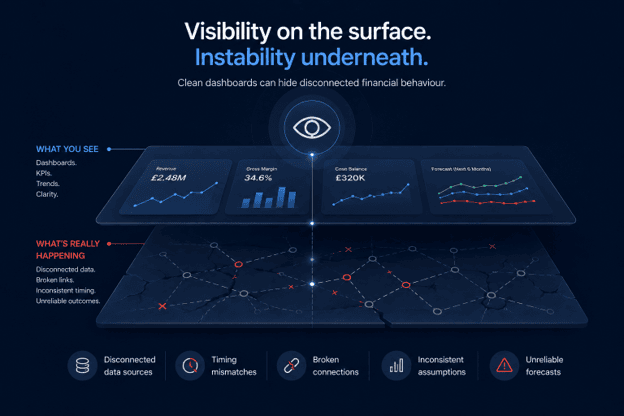
One of the risks with modern financial reporting is that unclear financial information can still look highly convincing.
Dashboards improve presentation.
But presentation is not the same as financial clarity.
A business can have:
- polished reporting
- clean KPI summaries
- visually impressive dashboards
while still struggling to explain:
- cash movement
- margin changes
- forecast accuracy
- operational performance
The issue is usually not the dashboard itself.
It is that the underlying financial information is not behaving consistently.
Key Takeaways
- Dashboards improve visibility, not reliability
- Clean presentation can create false confidence
- Financial clarity depends on connected reporting and forecasting
- Forecasts become unreliable when actuals drift from operational reality
- Growing SMEs need financial information that behaves consistently over time
- Software becomes significantly more useful when guided by financial expertise and structure
Why Dashboards Feel Reassuring
Dashboards feel reassuring because visual clarity is often mistaken for financial reliability.
Modern reporting tools are designed to simplify financial information.
They provide:
- charts
- KPIs
- trend analysis
- visual summaries
This creates a sense of control.
The reporting looks:
- organised
- structured
- professional
And because the presentation is clear, businesses often assume the underlying numbers are reliable too.
But those are not the same thing.
Why Visual Clarity Can Hide Financial Inconsistency
A dashboard only reflects the information feeding into it.
If the underlying reporting structure is inconsistent:
- forecasts drift from actual performance
- reporting categories evolve separately
- assumptions become fragmented
- timing differences become unclear
- the dashboard may still appear clean and well organised.
The visual layer can make inconsistent financial information look more certain than it actually is.
This is often where businesses begin trusting the presentation before validating the underlying financial behaviour.
Why Businesses Still Feel Unclear Even With Better Reporting
Many growing SMEs eventually experience a disconnect between:
- what the dashboard says
and
- how the business actually feels operationally
For example:
- revenue appears strong but cash feels tight
- margins fluctuate without obvious explanation
- forecasts look positive but performance remains unpredictable
- different reports show slightly different answers
At this stage, the issue is rarely a lack of reporting.
The issue is that the financial information driving the reporting is no longer fully connected.
How the Same Dashboard Can Produce Very Different Outcomes
The dashboard itself is rarely the differentiator.
The difference is the quality and consistency of the underlying financial structure.
| Area | Presentation-Led Reporting | Connected Financial Reporting |
| Dashboard outputs | Visually clear but operationally inconsistent | Clear and behaviourally reliable |
| Forecasting | Updated separately from actual performance | Extends directly from live financial information |
| Cash visibility | Difficult to explain timing differences | Cash behaviour remains visible and connected |
| Margin analysis | Trends appear but drivers remain unclear | Margins reflect operational activity consistently |
| Reporting confidence | Numbers require interpretation and reconciliation | Numbers remain aligned across reporting |
| Decision-making | Slower due to uncertainty underneath the reporting | Faster because financial behaviour is trusted |
Dashboards improve visibility.
Structure determines whether the numbers can actually be relied upon.
Why Forecasting Problems Often Stay Hidden
Forecasting issues rarely appear suddenly.
They usually build gradually over time.
As businesses scale:
- spreadsheets evolve separately
- assumptions become duplicated
- operational changes are layered onto old models
- actuals and forecasts drift apart slowly
Initially, the dashboard still looks stable.
But underneath:
- forecasting requires more manual correction
- reporting becomes harder to reconcile
- confidence in future projections weakens
The visual reporting remains clear long after the underlying financial behaviour becomes inconsistent.
Why Visibility Is Not the Same as Reliability
One of the biggest misconceptions in financial reporting is that visibility automatically creates clarity.
But visibility simply means the information can be seen.
Reliability depends on whether:
- the numbers remain consistent over time
- forecasts behave like the business itself
- reporting structures align operationally
- financial movements connect properly across the business
Visibility without reliability creates false confidence.
Why Better Financial Information Requires More Than Software
Software can improve reporting significantly.
But software alone does not create financial integrity.
Reliable financial information usually depends on:
- consistent reporting structures
- operationally accurate categorisation
- connected forecasting and actual performance
- financial expertise interpreting how the numbers behave over time
Software becomes most useful when the financial structure underneath it is already behaving properly.
This is often the difference between:
- reporting that looks professional
and
- reporting that genuinely supports decisions.
What Reliable Financial Visibility Actually Looks Like
Reliable financial visibility is usually much simpler than businesses expect.
It comes from:
- management accounts that reflect operational reality
- rolling forecasts connected directly to actual performance
- financial information that updates consistently over time
- reporting structures that explain operational behaviour clearly
This allows businesses to:
- understand cash timing
- identify operational pressure points
- forecast more confidently
- make decisions more quickly
A forecast is only useful if it behaves like the business itself.
Why This Matters as SMEs Scale
As SMEs grow:
- decisions become larger
- operational complexity increases
- timing differences become more material
- forecasting becomes more important
At that stage, polished reporting alone is not enough.
Businesses need financial information that:
- remains connected
- behaves consistently
- and continues reflecting operational reality as complexity increases
Otherwise, dashboards create confidence before the underlying numbers deserve it.
Better Dashboards Do Not Automatically Create Better Financial Clarity
Dashboards can improve presentation.
But presentation is not the same as operational understanding.
Reliable financial visibility depends on:
- connected reporting
- forecasting aligned with actual performance
- financial information that behaves consistently over time
Because businesses do not make decisions from dashboards alone. They make decisions from financial information they trust operationally.
If your reporting looks increasingly polished but forecasting, cash visibility, and operational decision-making still feel unclear, the issue may lie in the financial structure underneath the dashboard rather than the visual reporting itself.
As businesses scale, financial reporting often becomes easier to present but harder to rely on operationally.
That is usually the point where businesses need more than dashboards and retrospective reporting.
They need:
- financial information that remains connected over time
- forecasting that reflects actual operational behaviour
- reporting structures that continue making sense as complexity increases
FDPack works with growing SMEs to build financial reporting and forecasting systems that remain usable as the business evolves.
Because clearer dashboards only become valuable when the numbers underneath them behave properly.
FAQs
Why can dashboards still produce unclear financial reporting?
Because dashboards only reflect the underlying financial information feeding into them.
Why do forecasts drift from actual performance?
Because reporting structures, assumptions, and operational changes often become disconnected over time.
What creates reliable financial visibility?
Connected reporting, forecasting linked to actual performance, and financial information that behaves consistently over time.
Why can clean reporting still feel operationally unclear?
Because visual clarity does not automatically mean the underlying financial behaviour is reliable.
What makes financial information genuinely useful for decisions?
Consistency, operational accuracy, and forecasting that reflects how the business actually behaves

