
Financial Forecasting for SMEs
Financial forecasting for SMEs should centre around having a detailed business model that generates a live, integrated view of your Profit and Loss, Cash Flow, and Balance Sheet. Updated every month with the actual numbers. So you can make confident decisions about your business.

Financial forecasting that shows you where your business is heading, before it’s too late to act
Most business owners have some form of forecast. The problem is that most forecasts are a Profit and Loss projection on a spreadsheet. They show expected income and costs.
What they don’t show is whether you will have the cash to fund that activity. What your balance sheet looks like. Or what happens if one key assumption turns out to be wrong.
FDPack builds forecasts that integrate all three financial statements into a single live model, updated every month with your actual results.
The result: a financial picture you can trust and use to make real decisions.

Profit & Loss

Cashflow

Balance Sheet

Thank you for helping us to get our figures together. I can now sleep better at night.
William Moore, CEO of AirBox Systems

Why most SME financial forecasts fall short
A Profit and loss projection only tells part of the story.
It does not tell you whether the business has the cash to fund that level of activity. It does not show you when your tax bills land against your thinnest cash months. It does not answer the question every growing business owner faces sooner or later: can I actually afford to do this?
FDPack answers those questions. Every month. Before you have to make the decision.
Financial modelling and rolling forecasts
The unique FDPack forecasting methodology works with a high level of detail and double entry discipline to ensure we do the job “properly”. Our model is built with the following structure:
Drill down into the detail
Having separated the forecast into different transaction types and attached the appropriate accounting codes, our FDPack software is then able to create all the double entry transactions that describe the forecast or budget.
This creates a single database containing, actual, forecast and budget transactions all in the same double entry format, meaning that they can be easily analysed and presented in whatever combination is required.
If you drill down into any line of the forecast, you will see transaction level detail and not just a single figure, which is the assumed opening/closing balance movement used by some short cut forecasting methods.


Save Time with Smart Reporting
Like all jobs that are done properly, our FDPack methodology is initially more demanding and time consuming but has significant long-term benefits for the accuracy and reliability of the forecasts and budgets.
Applying these disciplines to forecasting and budgeting ensures that the three financial statements are integrated and reassures stakeholders that the business really understands the mechanics of its finances and its cash flow.

“The FDPack modelling technique is like renovating a classic car. At one point the parts are all over the garage floor but, by the time you have cleaned them up and put them back together again, you have an intimate knowledge of how the car works. Like any classic car it also needs continual attention to keep it running smoothly”
Simon Phippen, FDPack Consultant.

Blogs
Useful content to simplify and demystify a range of financial subjects
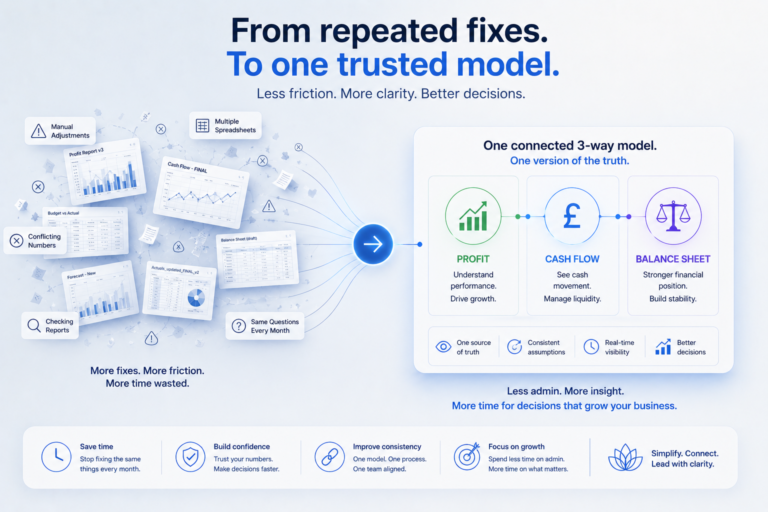
How Many Hours a Week Are You Wasting on “Fixing” Financial Admin?
Most business owners know what they pay for accounting. Few know what they pay for fixing accounting. Not the fee. The effort. The same questions being answered over and over again. None of these appear as a cost in the accounts. But they still consume time. And for many growing businesses, that time becomes a…
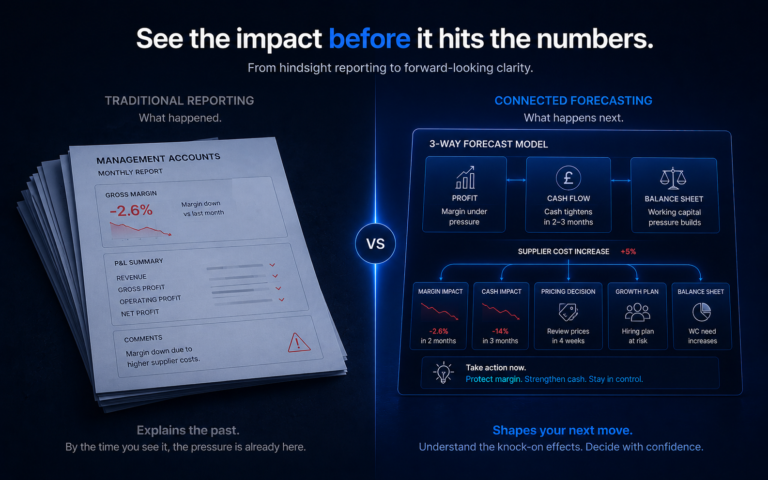
Why Rising Supplier Costs Often Cause Bigger Problems Than Businesses Expect
Most business owners expect rising supplier costs to reduce margins. What they often miss is everything that happens next. The issue is rarely the cost increase itself. The issue is understanding how that increase moves through the business before it appears in the monthly accounts. By the time the impact shows up clearly in the…
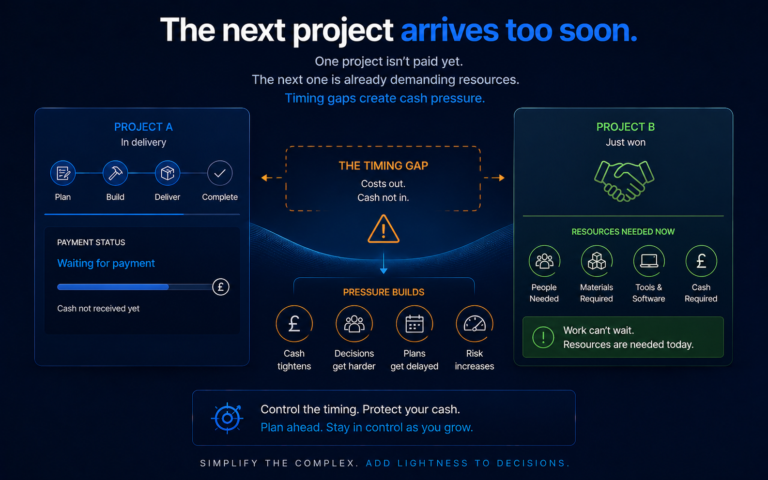
How Can Project-Based Businesses Grow Without Losing Control Of Cash?
Growth creates a unique challenge for project-based businesses. The next project often arrives before the previous one has been paid for. That sounds manageable when projects are small. As projects become larger, the gap becomes more important. The challenge is not winning the next project. The challenge is understanding what those projects require before commitments…
Sign up to receive useful content directly into your inbox
Actionable tips, financial insight and expert advice all in one place
We will never share your details with third parties! Read our privacy policy.